SÚKL, in the reimbursement review, assessed the expansion of JAK
inhibitors reimbursement for rheumatoid arthritis ("RA") with
moderate disease activity as sufficiently supported by clinical data and
desirable for clinical practice in the Czech Republic.
Given that such an expansion of reimbursement conditions would result in
an increase in the number of treated patients, it is necessary to evaluate the
cost-effectiveness and the budget impact. Since SÚKL did not receive a
pharmacoeconomic evaluation from the participants in the required scope, the
expansion of reimbursement for rheumatoid arthritis with moderate disease
activity was carried out by setting the reimbursement for JAKi at the cost
level of another therapy that is (at least) equally effective and already
reimbursed for the target group of patients with RA and moderate disease
activity. The approach chosen by SÚKL in the ongoing reimbursement review,
therefore, by setting two reimbursement levels, ensures that JAKi remain
reimbursed for RA with high disease activity in the second and subsequent lines
of treatment with higher reimbursement, while JAKi are also newly reimbursed
for moderate disease activity, though at a lower reimbursement amount.
The participant argued that a medicinal product may only have one
additional increased reimbursement level set, alongside the basic reimbursement
(not multiple increased reimbursement levels, as SÚKL did). SÚKL refers to
Section 39b, paragraph 11 of the Health Insurance Act, which does not exclude
the possibility of applying it based on the evaluation of a medicinal
substance, product, or pharmaceutical form for several selected indications or
for multiple patient groups.
SÚKL also states that during the ongoing reimbursement review, no
statements were received from payers regarding any difficulties in reporting
healthcare when establishing multiple reimbursement levels.
Articles from decision-making practice are based on publicly available
texts from decisions by the Ministry of Health of the Czech Republic and
decisions by SÚKL.
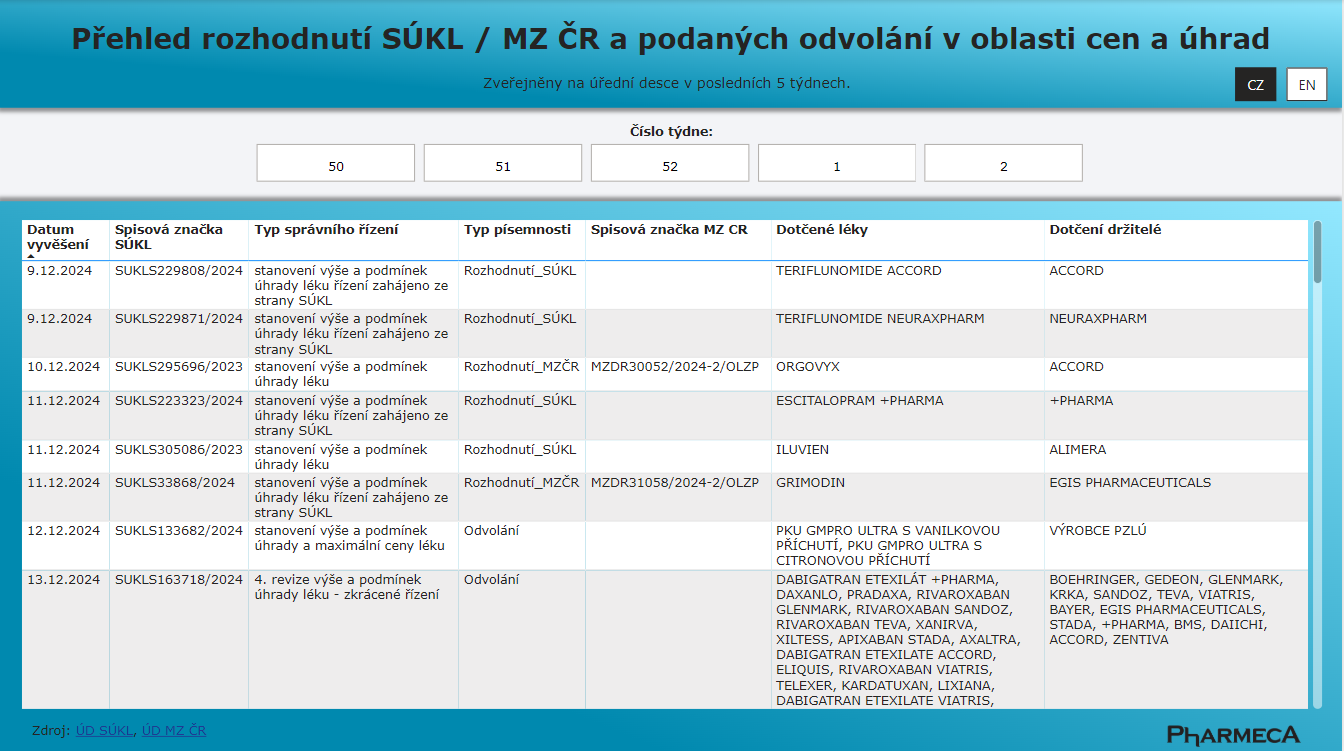
On the website of Pharmeca a.s., you can continuously follow an overview of the pricing and reimbursement decisions issued by SÚKL and the Ministry of Health of the Czech Republic.
Articles on decision-making practice are based on publicly available texts of the Ministry of Health and SÚKL decisions.
Are you interested in reading regular commentaries on decisions by
Pharmeca a.s.? Feel free to contact us.
At Pharmeca, we help you navigate the complex landscape of
pharmaceutical and medical device information. We also offer flexible services
that can be tailored to your needs at any time.
Our market position and experience allow us to support you whenever you
need expert guidance.
The European Medicines Agency (EMA) has
announced the launch of a new platform designed to routinely monitor shortages
of centrally authorized medicines. This platform is a direct result of Regulation
(EU) 2022/123, which aims to improve preparedness for and mitigation of
medicine shortages across EU member states.
Key Points:
Platform
Availability:
The European Shortages Monitoring Platform (ESMP) is now accessible
online.
Mandatory
Usage:
Starting from February 2, 2025, all Marketing Authorization Holders (MAHs)
with centrally authorized products will be required to use the ESMP.
Early
Familiarity:
EMA encourages MAHs to familiarize themselves with the platform before the
mandatory deadline.
Data
Submission:
Until February 2, 2025, MAHs and National Competent Authorities (NCAs) can
submit data on supply, demand, and availability of both centrally and
nationally authorized medicines to the EMA's Executive Steering Group on
Shortages and Safety of Medicinal Products (MSSG).
Medicine
Monitoring:
The platform will be used for routine monitoring of all centrally
authorized medicines and may also be used for monitoring nationally
authorized medicines under special circumstances.
The European Medicines Agency (EMA) has announced the launch of a new platform designed to routinely monitor shortages of centrally authorized medicines.
Starting january 1, 2025, Pharmeca a.s. will provide an overview of issued decisions by the State Institute for Drug Control (SÚKL) and the Ministry of Health of the Czech Republic (MZ ČR) related to pricing and reimbursement on its website.
For marketing authorization holders, knowledge of SÚKL and MZ ČR decisions in the area of pricing and reimbursement is essential. The outcomes of individual proceedings shape decision-making practices that influence future decisions.
To address this need, Pharmeca a.s. now offers an interactive overview of decisions issued in the past five weeks.
The European Medicines Agency (EMA) has
announced the launch of a new platform designed to routinely monitor shortages
of centrally authorized medicines. This platform is a direct result of Regulation
(EU) 2022/123, which aims to improve preparedness for and mitigation of
medicine shortages across EU member states.
Key Points:
Platform
Availability:
The European Shortages Monitoring Platform (ESMP) is now accessible
online.
Mandatory
Usage:
Starting from February 2, 2025, all Marketing Authorization Holders (MAHs)
with centrally authorized products will be required to use the ESMP.
Early
Familiarity:
EMA encourages MAHs to familiarize themselves with the platform before the
mandatory deadline.
Data
Submission:
Until February 2, 2025, MAHs and National Competent Authorities (NCAs) can
submit data on supply, demand, and availability of both centrally and
nationally authorized medicines to the EMA's Executive Steering Group on
Shortages and Safety of Medicinal Products (MSSG).
Medicine
Monitoring:
The platform will be used for routine monitoring of all centrally
authorized medicines and may also be used for monitoring nationally
authorized medicines under special circumstances.
The European Medicines Agency (EMA) has announced the launch of a new platform designed to routinely monitor shortages of centrally authorized medicines.
The European Health Data Space should lead to the empowerment of citizens and support for research and innovation.
EU residents will have more control over their health data,
being able to access it electronically and share it across borders. This
is particularly beneficial for cross-border healthcare, allowing
individuals to access medical records and receive care seamlessly
throughout the EU.
The EHDS promotes the secondary
use of health data for research, innovation, and policy-making.
Researchers and innovators will be able to access health data more easily
and securely, which could drive the development of new treatments, medical
devices, and AI applications.
The main objectives of the European Health Data Space (source: excerpt from the Communication from the Commission to the European Parliament and the Council: The European Health Data Space: Harnessing the power of health data for people, patients, and innovation):
The European Health Data Space (EHDS) has advanced significantly since the initial concept of a digital transformation in healthcare across all EU member states.
CTIS byl
zřízen farmaceutickým zákonem v rámci Nařízení o klinických studiích (Nařízení (EU) č. 536/2014) a po 30.
lednu 2025 kompletně nahradí původní systém pro klinické studie EudraCT
(Databáze klinických studií orgánů pro regulaci léčiv Evropské unie).
Evropská léková agentura (EMA) průběžně
publikuje zprávy, jak proces přechodu na nový systém pokračuje.
V předchozím článku jsme
ukazovali, jaká byla situace v únoru 2024, v tomto článku jsme informace o počtu
podání a rozhodnutí o přechodu aktualizovali ke konci srpna 2024.
Obr. č. 1 – Změny v počtu
podaných žádostí, resp. v počtu podání, kde již bylo rozhodnuto, v porovnání
s předchozím měsícem
CTIS was established by pharmaceutical law in the Clinical Trials Regulation (Regulation (EU) No 536/2014) and will completely replace the previous system for clinical trials EudraCT (European Union Drug Regulating Authorities Clinical Trials Database) after 30th January 2025. CTIS supports interactions between clinical trial sponsors (researchers or companies that run a clinical trial and collect and analyse the data) and regulatory authorities in the EU Member States and EEA countries, throughout the lifecycle of a clinical trial.
CTIS is guaranteed by European Medicines
agency (EMA) and works in a secured workspace.
The important milestones for clinical trials:
CT starts after
30th January 2023 – the submission must be completed through CTIS
CT ends before
30th January 2025 – CT is maintained in EudraCT or national
systems
CT is expected
to continue after 30th January 2025 – transition from the EudraCT or
national systems to the CTIS is necessary.
CTIS podporuje interakce mezi sponzory klinických studií (výzkumníky nebo společnostmi, které provádějí klinickou studii a shromažďují a analyzují data) a regulačními orgány v členských státech EU...
Based on the amendment to Act
No. 235/2004 Coll., on Value Added Tax, as of January 1, 2024, there has been a
change in VAT rates, particularly impacting the increase in prices and
reimbursements for medicinal products. In the infographics, we will illustrate
how the individual rates have changed and examine the international comparison
to assess the impact on the Czech Republic.
While the standard VAT rate
remains at 21 percent, the original reduced rates of 15 percent (for medical
devices) and 10 percent (for medicinal products) have been unified into a
single 12 percent rate. The newly introduced zero rate applies exclusively to
books, although the inclusion of medicinal products could have been possible in
line with European legislation.
The infographics provides an
overview of the changes in rates as follows:
Based on the amendment to Act No. 235/2004 Coll., on Value Added Tax, as of January 1, 2024, there has been a change in VAT rates, particularly impacting the increase in prices and reimbursements...