In
2025, 12 decisions of the State Institute for Drug Control(SÚKL) became
legally effective in administrative proceedings relating to the determination
of price and reimbursement for orphan medicinal products. Although the system
introduced in 2022 is formally structured around SÚKL decisions, the Institute
may not deviate from the binding opinion of the Ministry of Health of the Czech Republic.
In 2025, SÚKL issued a total of 12 final decisions in proceedings concerning the determination of price and reimbursement for orphan medicinal products, based on binding opinions of the Ministry of...
The State Institute for Drug Control decided on the determination of the maximum price and reimbursement for a medicinal product containing the active substance tamoxifen citrate.
The proceedings were initiated upon the company’s application pursuant to Section 32d of the Public Health Insurance Act. The purpose of this specific procedure is to ensure the availability of irreplaceable medicinal products in situations where a supply disruption in the Czech Republic is imminent or has already occurred.
The primary reason for the decision was to ensure continued treatment availability for oncology patients, as supply of the previously registered medicinal products containing the above active substance had been interrupted for manufacturing reasons. As no other registered alternative for oral administration was available within the relevant group, the Ministry of Health approved a specific treatment programme for an unregistered medicinal product. The Institute subsequently determined its maximum price and reimbursement level, adopting the reimbursement conditions of the originally reimbursed product that had become unavailable.
The decision on the determination of price and reimbursement was issued 24 days after submission of the application.
Are you interested in reading regular commentaries on decisions by
Pharmeca a.s.? Feel free to contact us.
At Pharmeca, we help you navigate the complex landscape of
pharmaceutical and medical device information. We also offer flexible services
that can be tailored to your needs at any time.
Our market position and experience allow us to support you whenever you
need expert guidance.
A continuously
updated overview of decisions issued by SÚKL and the Ministry of Health in the
field of pricing and reimbursement is available on the Pharmeca a.s. website.
The State Institute for Drug Control (hereinafter the “Institute”) informs about current service outages of Verso and DSŘ (documents of CAU administrative proceedings). The reason for these outages is unforeseen technical issues on the side of an external supplier. Intensive work is underway to resolve the problem with the aim of restoring full system functionality as soon as possible. System adjustments have been implemented to eliminate the causes of the issues, along with improved monitoring and control of errors arising from this situation.
At this time, we can confirm that access to case files via the Verso application when logged in using the National Identification and Authentication Point (NIA), i.e. the so-called citizen identity, is functioning without limitations. Unfortunately, complications persist with access without login, which we are actively addressing.
We therefore recommend using login via citizen identity when accessing Verso.
Recommended Procedures for Affected Parties to Administrative Proceedings
In-person access to the case file Access to the case file pursuant to Section 38 of Act No. 500/2004 Coll., the Administrative Procedure Code, remains available at the Institute’s premises. When: Working days, 8:00–16:00 Where: SÚKL headquarters – Building B (Benešovská 2538/40, 101 00 Prague 10) Contact for appointment booking: cau_sekretariat@sukl.gov.cz
Monitoring the Official Notice Board Due to the technical outage, participants in administrative proceedings are advised to pay increased attention to monitoring the Institute’sOfficial Notice Board. Documents published by way of public notice in proceedings under Part Six of Act No. 48/1997 Coll., on Public Health Insurance, may be posted there and may include deadlines for procedural actions.
Procedural Deadlines and Applications If a technical obstacle on the part of the Institute objectively prevents a party from performing a procedural act within the prescribed time limit, the following instruments under the Administrative Procedure Code may be used: Extension of a deadline / suspension of proceedings: This may be requested if there is a risk of missing a deadline due to the unavailability of remote access. The request must be submitted sufficiently in advance. Waiver of missed deadline: If a deadline has already expired, the party may request a waiver pursuant to Section 41(2) of the Administrative Procedure Code. Each such request will be assessed individually, taking into account the current technical situation.
Note: Information on the restoration of the Verso system will be published on this page without delay. We apologise for the inconvenience caused and thank you for your understanding.
FAQ
1) Is it currently possible to access a case file?
Yes, in person at the Institute’s premises, Monday–Friday, 8:00–16:00. The Verso service may be temporarily unavailable.
2) What is DSŘ and can it be used instead of case file access?
DSŘ is an automated method for downloading selected documents (system-to-system communication). It is not an alternative to access to the case file under Section 38 of the Administrative Procedure Code and cannot replace it. DSŘ availability may be limited.
3) I am unable to meet a deadline due to the outage — what should I do?
Submit a timely request for an extension of the deadline or suspension of proceedings; after the deadline has expired, you may request a waiver pursuant to Section 41(2) of the Administrative Procedure Code.
4) How should I proceed if I need a specific document?
Book an in-person file inspection; for general orientation in the proceedings, continuously monitor the Official Notice Board.
The text of this article was taken in full from the SÚKL website.
SÚKL warns of possible limitations affecting remote access to case files via the Verso application and automated access to documents of administrative proceedings in CAU (DSŘ).
The Institute
initiated an ex officio abbreviated reimbursement review on the grounds
of the entry of the first similar medicinal product into the
reimbursement system, without undue delay after verifying that the product
concerned had been placed on the Czech market.
However, one of
the affected marketing authorisation holders appealed against the initiation of
the proceedings, arguing that the entering product was not the first similar
medicinal product and referring to earlier proceedings in which the newly
entering product had not been assessed as similar.
The Ministry of
Health (MoH) rejected this objection, stating that although in the referenced
proceedings the assessed product and the reference (originator) product
contained the same active substance, they differed in dosage, standardisation
units and pharmaceutical forms. At the same time, the products were assessed
against additional criteria—such as therapeutic indications or pharmacological
properties—and, on that basis as well, were not considered similar.
In the present
case, however, the MoH considers the medicinal product concerned to be a generic
within the meaning of the Act on Medicinal Products. The products involved in
the proceedings contain the same active substance and a comparable
pharmaceutical form as the reference product, and the appellant repeatedly
failed to demonstrate otherwise.
In the case under
review, the conditions for initiating a review on the grounds of the entry of
the first similar medicinal product were therefore met.
The MoH further notes that although, under the legislation applicable at the time, SÚKL could have initiated the proceedings earlier, the appellate authority considers the approach whereby SÚKL waited for the first actual supply of the medicinal product concerned to be appropriate and well justified. This prevented a reduction in reimbursement for similar products based on a first similar medicinal product that was not yet commercially available.
Pursuant to the amendment to the Public Health Insurance Act, in abbreviated reviews initiated after 1 January 2026, there is now an obligation to verify market availability at a minimum level of 5%, or 2% for ZÚLP.
Are you interested in reading regular commentaries on decisions by
Pharmeca a.s.? Feel free to contact us.
At Pharmeca, we help you navigate the complex landscape of
pharmaceutical and medical device information. We also offer flexible services
that can be tailored to your needs at any time.
Our market position and experience allow us to support you whenever you
need expert guidance.
A continuously
updated overview of decisions issued by SÚKL and the Ministry of Health in the
field of pricing and reimbursement is available on the Pharmeca a.s. website.
The State Institute for Drug Control (SÚKL) has published an updated, already 3rd version of Guideline CAU-08 – Requirements for the structure of expert documentation supplementing an application and for the structure of statements of other participants when submitting evidence in proceedings on the determination or change of the amount and conditions of reimbursement of medicinal products / partially reimbursed medicinal products, effective as of 2 January 2026.
The main change is the introduction of a new Annex No. 5 – Structured Submission A for marketing authorisation holders – immunisation.
SÚKL has published an updated version of guideline CAU-08 - Requirements on the structure of technical documentation to be submitted along with applications and on the structure of opinions of...
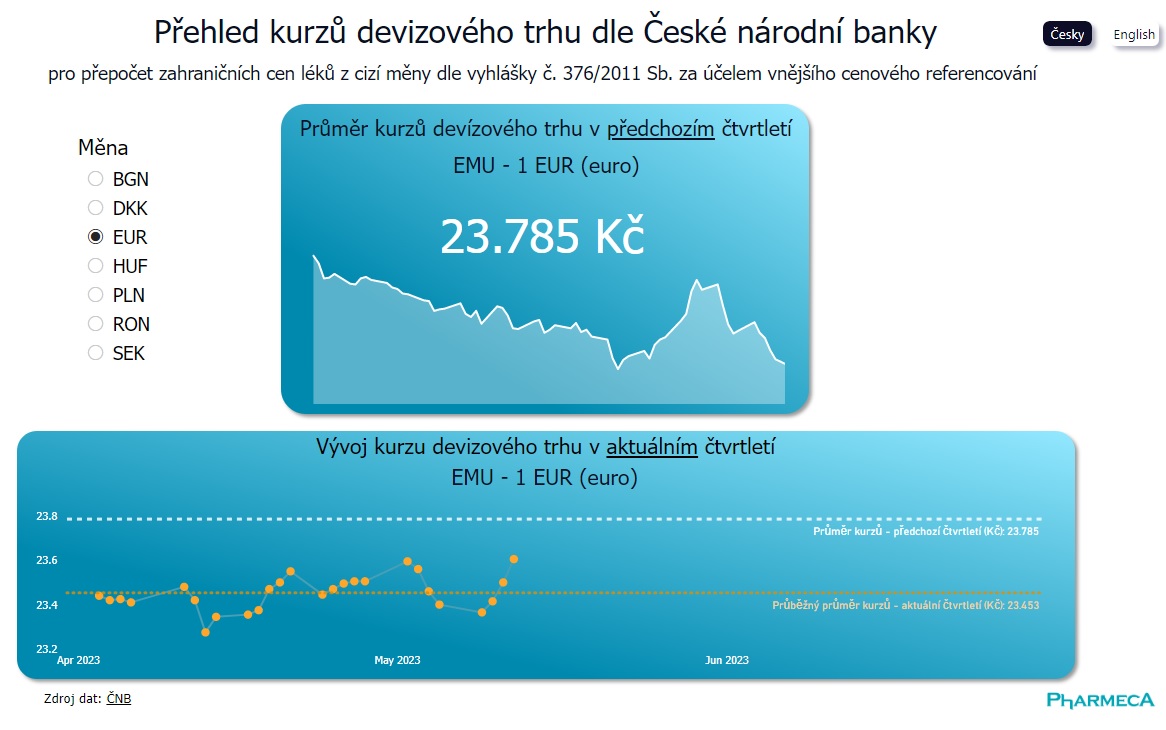
The determination of prices and reimbursement of medicinal
products is based on external price referencing, within which foreign
prices denominated in foreign currencies are converted into Czech crowns.
Currently, foreign prices are converted using the quarterly
average exchange rate published by the Czech National Bank for the calendar
quarter preceding the calendar quarter in which the administrative proceedings
were initiated (the “relevant exchange rate”).
According to the amendment to the implementing decree, where
no more than three manufacturer prices of a given medicinal product are
available and the relevant exchange rate differs by more than 10 % from
the average exchange rates over the six quarters preceding the relevant
exchange rate, the conversion for the affected medicinal product is carried
out using the average exchange rate over those six quarters.
Where more than three manufacturer pricesof a given
medicinal product are availableand the relevant exchange rate differs by more
than 10 %from the average exchange rates over the six quarters preceding
the relevant exchange rate, such a price is excluded from the calculation.
To make it easier to assess whether these conditions are
met, we have updated a visual support tool on our website.
With a single
click, you can now find not only the relevant average exchange rate for the
preceding quarter but also its deviation compared to the previous six quarters.
The amendment to the Public Health Insurance Act and its implementing decrees has introduced changes, effective from the beginning of the year, also in the way exchange rates are applied for price...
Drug pricing and reimbursement are based on price referencing, where the foreign price in a foreign currency is converted into Czech koruna. For this purpose, it is essential to obtain the quarterly average exchange rate for the foreign exchange market, as published by the Czech National Bank.
Our new online overview provides: ✔ The required average exchange rate from the previous quarter ✔ The exchange rate development in the current quarter ✔ A monitoring focus on the 6 most commonly used European exchange rates in administrative proceedings
The key information for conducting price referencing in administrative procedures for drug pricing and reimbursement is the average exchange rate from the previous quarter. Now, you can easily...
The State Institute for Drug Control (SÚKL) has published an updated, already 3rd version of Guideline CAU-08 – Requirements for the structure of expert documentation supplementing an application and for the structure of statements of other participants when submitting evidence in proceedings on the determination or change of the amount and conditions of reimbursement of medicinal products / partially reimbursed medicinal products, effective as of 2 January 2026.
The main change is the introduction of a new Annex No. 5 – Structured Submission A for marketing authorisation holders – immunisation.
SÚKL has published an updated version of guideline CAU-08 - Requirements on the structure of technical documentation to be submitted along with applications and on the structure of opinions of...
The State Institute for Drug Control (SÚKL) has published an updated, already 3rd version of Guideline CAU-08 – Requirements for the structure of expert documentation supplementing an application and for the structure of statements of other participants when submitting evidence in proceedings on the determination or change of the amount and conditions of reimbursement of medicinal products / partially reimbursed medicinal products, effective as of 2 January 2026.
The main change is the introduction of a new Annex No. 5 – Structured Submission A for marketing authorisation holders – immunisation.
SÚKL has published an updated version of guideline CAU-08 - Requirements on the structure of technical documentation to be submitted along with applications and on the structure of opinions of...
The Ministry of Health (MoH) assessed whether the conditions
for increasing reimbursement on the grounds of ensuring at least one fully
reimbursed medicinal product within a group of substitutable products had been
met in the context of a comprehensive review (Section 39c(5) of the Public
Health Insurance Act).
According to the MoH, it was not possibleto designate the
product referenced in the proceedings as a relevant fully reimbursed medicinal
product for two main reasons:
the referenced product had
reported an interruption of its placing on the domestic market effective as of
25 December 2023, i.e. prior to the date on which the contested decision
(issued on 27 November 2023) became enforceable. In the case of a product with
a notified interruption, a temporary supply disruption may reasonably be
assumed, and consequently the practical impossibility of its full
reimbursement;
the referenced product is also
reimbursed for the treatment of bladder cancer. The products for which the
reimbursement increase was assessed are reimbursed exclusively for patients
with renal cancer and soft tissue sarcoma. Although bladder cancer and renal
cancer both fall under carcinomas of the urogenital tract, the MoH does not
consider them to constitute diseases of the same type within the meaning of the
legal opinion of the Constitutional Court.
Full reimbursement for the group of patients with the
indication of bladder cancer could therefore not be ensured through the
assessed product but was secured through other medicinal products.
Are you interested in reading regular commentaries on decisions by
Pharmeca a.s.? Feel free to contact us.
At Pharmeca, we help you navigate the complex landscape of
pharmaceutical and medical device information. We also offer flexible services
that can be tailored to your needs at any time.
Our market position and experience allow us to support you whenever you
need expert guidance.
A continuously
updated overview of decisions issued by SÚKL and the Ministry of Health in the
field of pricing and reimbursement is available on the Pharmeca a.s. website.
The State Institute for Drug Control (SÚKL) has published an updated, already 3rd version of Guideline CAU-08 – Requirements for the structure of expert documentation supplementing an application and for the structure of statements of other participants when submitting evidence in proceedings on the determination or change of the amount and conditions of reimbursement of medicinal products / partially reimbursed medicinal products, effective as of 2 January 2026.
The main change is the introduction of a new Annex No. 5 – Structured Submission A for marketing authorisation holders – immunisation.
SÚKL has published an updated version of guideline CAU-08 - Requirements on the structure of technical documentation to be submitted along with applications and on the structure of opinions of...
The State Institute for Drug Control (SÚKL) has published an updated, already 3rd version of Guideline CAU-08 – Requirements for the structure of expert documentation supplementing an application and for the structure of statements of other participants when submitting evidence in proceedings on the determination or change of the amount and conditions of reimbursement of medicinal products / partially reimbursed medicinal products, effective as of 2 January 2026.
The main change is the introduction of a new Annex No. 5 – Structured Submission A for marketing authorisation holders – immunisation.
SÚKL has published an updated version of guideline CAU-08 - Requirements on the structure of technical documentation to be submitted along with applications and on the structure of opinions of...
The State Institute for Drug Control (SÚKL) has published an updated, already 3rd version of Guideline CAU-08 – Requirements for the structure of expert documentation supplementing an application and for the structure of statements of other participants when submitting evidence in proceedings on the determination or change of the amount and conditions of reimbursement of medicinal products / partially reimbursed medicinal products, effective as of 2 January 2026.
The main change is the introduction of a new Annex No. 5 – Structured Submission A for marketing authorisation holders – immunisation.
SÚKL has published an updated version of guideline CAU-08 - Requirements on the structure of technical documentation to be submitted along with applications and on the structure of opinions of...
The State Institute for Drug Control (SÚKL) has published an updated, already 3rd version of Guideline CAU-08 – Requirements for the structure of expert documentation supplementing an application and for the structure of statements of other participants when submitting evidence in proceedings on the determination or change of the amount and conditions of reimbursement of medicinal products / partially reimbursed medicinal products, effective as of 2 January 2026.
The main change is the introduction of a new Annex No. 5 – Structured Submission A for marketing authorisation holders – immunisation.
SÚKL has published an updated version of guideline CAU-08 - Requirements on the structure of technical documentation to be submitted along with applications and on the structure of opinions of...
Pharmeca a.s. provides
services within the scope defined by the following legislative framework:
Act No. 48/1997 Coll.,on
Public Health Insurance and on Amendments to Certain Related Acts, as
amended.
Implementing regulations
(selected):
Decree
No. 376/2011 Coll.,
implementing certain provisions of the Public Health Insurance Act, as
amended,
Notice of the Ministry of Health No. 529/2025 Coll., on the
antigenic composition of vaccines against pneumococcal infections for
vaccination of insured persons over 65 years of age
Notice of the Ministry of Health No. 23/2024 Coll., on the
antigenic composition of vaccines against pneumococcal infections for childhood
vaccination and for insured persons with health risk factors
Notice of the Ministry of Health No. 273/2024 Coll., on the
antigenic composition of reimbursed vaccines for influenza vaccination of
persons over 65 years of age
Notice of the Ministry of Health No. 474/2021 Coll., on the
antigenic composition of reimbursed vaccines against human papillomavirus
Decree No. 432/2025 Coll., on the
determination of the value of a point, reimbursement levels for reimbursed
services, advance payments, and regulatory limitations for 2026
Notice of the Czech Statistical Office No. 159/2018 Coll.,
introducing the CZ-DRG classification of hospitalized patients
Decree No 384/2007 Coll., on
the list of reference groups, as amended,
Decree No 385/2007 Coll., on
the list of medicinal substances intended for supportive or adjunctive
treatment, as amended,
Decree No. 63/2007 Coll., on reimbursement
of medicinal products and foods for special medical purposes, as amended.
Decree No. 618/2006 Coll., issuing
framework contracts, as amended,
Decree No. 134/1998 Coll., issuing
the list of healthcare procedures with point values, as amended,
Decree No. 527/2021 Coll., on
the determination of the amount of reimbursement of expenses for expert
acts and the method for determining the amount of reimbursement of
expenses for expert consultations carried out by the State Institute for
Drug Control pursuant to the Act on Public Health Insurance, as amended,
Decree on the determination of the value of a
point, reimbursement levels for reimbursed services and regulatory
limitations – issued annually for the relevant period,
Government Regulation No. 307/2012 Coll., on
local and temporal availability of healthcare services, as amended.
Act No. 551/1991 Coll.,
on the General Health Insurance Company of the Czech Republic, as
amended.
Act No. 280/1992 Coll.,
on sectoral, professional, company and other health insurance companies, as
amended.
Implementing regulations to the
Health Insurance Acts (selected):
Decree No. 421/2025 Coll., on the
determination of certain contributions from the fund of generally
beneficial activities of the General Health Insurance Company of the Czech
Republic and sectoral, professional, company and other health insurance
companies for 2026, as amended
Decree No. 125/2018 Coll., on
information contained in health insurance plans and outlooks and on the
method of their submission by health insurance companies, as amended
Decree No. 362/2010 Coll., on the
method of providing information on the financial management of health
insurance companies and its scope, as amended
Decree No. 418/2003 Coll., laying
down more detailed specification of the scope and amount of income and
expenditure of public health insurance funds of health insurance
companies, the conditions for their creation, use, permissibility of
mutual transfers of financial resources and their management, the limit of
operating costs of health insurance companies covered from the resources
of the basic fund including the method of calculation of this limit, as
amended
Decree No. 41/2000 Coll., laying
down detailed conditions for the creation and use of financial resources
of the funds of the Military Health Insurance Company of the Czech
Republic for reimbursement of healthcare provided beyond the scope of
public health insurance from the state budget resources of the Ministry of
Defence, as amended
Measure of the Ministry of Health determining
financial performance indicators of health insurance companies for the
relevant year
Act No. 592/1992 Coll.,
on Premiums for Public Health Insurance, as amended.
Implementing Regulation:
Government Regulation No. 357/2025 Coll., on the
assessment base for public health insurance premiums paid by the state for
2026
Decree No. 107/2025 Coll., on
adjustable parameters of redistribution of public health insurance
premiums for 2026 and on the content, structure and format of data for
calculation of the calculated redistribution parameters
Decree No. 65/2025 Coll., on the
method of valuation of costs of healthcare services for the purposes of
redistribution of public health insurance premiums
Decree No. 351/2022 Coll., on
the transfer of data on consumption of medicinal products by insured
persons of public health insurance when changing a health insurance
company, as amended
Price Decision of the Ministry of Health No.
1/2026/OLZP, on price regulation of medicinal products and foods for special
medical purposes
Price Decision of the Ministry of Health No.
2/2026/OLZP, establishing the list of ATC groups of medicinal products
significant for the provision of healthcare, for which the maximum manufacturer
price is determined in the public interest of ensuring availability
Price Decision No. 2/2025/OLZP, on price regulation
of individually prepared medicinal products containing cannabis for medical use
Price Regulation of the Ministry of Health No.
4/2024/OLZP, on the determination of a special distribution margin for
medicinal products released from reserve stock system,
Price Decision of the Ministry of Health No.
3/2026/OLZP of 24 October 2025, on price regulation of medical devices and
in vitro diagnostic medical devices
Act No. 378/2007 Coll.,
on Medicinal Products and on Amendments to Certain Related Acts, as
amended.
Implementing regulation
(selected):
Government Regulation No. 552/2025 Coll., on
conditions for prescribing, dispensing and use of individually prepared
medicinal products containing psilocybin for medical use
Decree No. 457/2023 Coll., laying down
the list of human medicinal products to which the obligation of the marketing
authorisation holder to ensure their supply after the notified date of
interruption or termination of supplies does not apply, as amended.
Decree No. 84/2008 Coll., on
Good Pharmacy Practice, on detailed conditions for handling medicinal
products in pharmacies, healthcare facilities and by other operators and
establishments dispensing medicinal products, as amended,
Decree No. 85/2008 Coll., laying
down the list of medicinal substances and excipients that may be used for
the preparation of medicinal products, as amended,
Decree No. 86/2008 Coll., laying
down the principles of Good Laboratory Practice in the field of medicinal
products, as amended
Decree No. 106/2008 Coll., on
Good Practice for sellers of restricted medicinal products and on the
professional training course for sellers of restricted medicinal products,
as amended
Decree No. 143/2008 Coll., on
human blood, as amended
Decree No. 228/2008 Coll., on
registration of medicinal products, as amended,
Decree No. 229/2008 Coll.,
on the manufacture and distribution of medicinal products, as amended,
Decree No. 236/2015 Coll., laying
down the conditions for prescribing, preparation, distribution, dispensing
and use of individually prepared medicinal products containing cannabis
for medical use, as amended,
Decree No. 329/2019 Coll.,
on prescribing medicinal products in the provision of healthcare services,
as amended,
Decree No. 463/2021 Coll.,
on the detailed conditions for conduct of clinical trials of human medicinal
products, as amended.
Act No 167/1998 Coll,
on Addictive Substances and on Amendments to Certain Other Acts, as amended
Implementing regulation
(selected):
Government Regulation No. 552/2025 Coll., on the
conditions for prescribing, dispensing and use of individually prepared
medicinal products containing psilocybin for medical use, as amended
Government Regulation No. 456/2025 Coll., on the list
of psychomodulatory substances, as amended
Decree No. 448/2025 Coll., on
psychomodulatory substances, as amended
Decree No. 349/2025 Coll., on the
requirements for notifications submitted by persons cultivating opium poppy and
technical hemp, as amended
Decree No. 147/2025 Coll., on specimen
forms and records of psychomodulatory substances and classified psychoactive
substances, as amended
Government Regulation No. 11/2025 Coll., on the list
of classified psychoactive substances, as amended
Decree No. 53/2014 Coll., on
official forms pursuant to the Act on Addictive Substances, as amended,
Decree No. 123/2006 Coll., on
records and documentation of addictive substances and preparations
containing them, as amended,
Decree No. 243/2009 Coll., laying
down the list of persons, including specification of their workplaces, for
whose activities no permit for handling addictive substances or
preparations containing them is required, as amended,
Government Regulation No. 463/2013 Coll.,
on the lists of addictive substances, as amended,
Decree No. 235/2022 Coll.,
on the cultivation and processing of cannabis plants for medicinal use, as
amended,
Decree No 53/2022 Coll., on
the determination of the amount of reimbursement of expenses for expert
acts carried out by the State Institute for Drug Control pursuant to the
Act on Addictive Substances, as amended.
Decree No. 329/2019 Coll., on
prescribing medicinal products in the provision of healthcare services, as
amended by Decree No. 53/2020 Coll., as amended
Act No. 288/2025 Coll., on the
Categorisation of Medical Devices Prescribed on Vouchers Reimbursed from Public
Health Insurance and on Amendments to Act No. 48/1997 Coll., on Public Health
Insurance and on Amendments to Certain Related Acts (the Medical Devices
Categorisation Act), as amended
Act No. 375/2022 Coll.,
on Medical Devices and In Vitro Diagnostic Medical Devices, as
amended.
Implementing regulation
(selected):
Decree No 377/2022 Coll., implementing
certain provisions of the Act on Medical Devices and In Vitro Diagnostic
Medical Devices, as amended,
Decree No. 378/2022 Coll., on the
specimen inspector identification card of the State Institute for Drug Control
pursuant to the Act on Medical Devices and In Vitro Diagnostic Medical Devices,
as amended.
Decree No 379/2022 Coll., on
the determination of the amount of reimbursement of expenses for expert
acts carried out by the State Institute for Drug Control pursuant to the
Act on Medical Devices and In Vitro Diagnostic Medical Devices, as
amended.
Act No 376/2022 Coll.,
amending certain Acts in connection with the adoption of the Act on Medical
Devices and In Vitro Diagnostic Medical Devices, as amended.
Act No.268/2014 Coll.,In
Vitro Diagnostic Medical Devices, as amended.
Act No. 89/2021 Coll.,
on Medical Devices and on Amendments to Act No. 378/2007 Coll., on Medicinal
Products and on Amendments to Certain Related Acts (the Medicinal Products Act),
as amended.
Implementing regulation:
Notification of the Ministry of Health No. 54/2022 Coll., on the
commissioning of the central repository of electronic vouchers.
Act No. 22/1997 Coll., on
Technical Requirements for Products and on Amendments to Certain Related Acts,
as amended.
Act No. 90/2016 Coll.,
on Conformity Assessment of Specified Products when Supplied on the Market, as
amended.
Act No. 325/2021 Coll., on
Healthcare Digitalisation, as amended, and other related acts, as amended
Act No. 372/2011 Coll.,
on Health Services and Conditions for Their Provision (the Health
Services Act), as amended.
Implementing regulations
(selected):
Decree No. 380/2025 Coll., on
emergency medical on-call services, as amended
Decree No. 30/2025 Coll., on
telemedicine health services, as amended
Decree No. 444/2024 Coll., on
healthcare documentation, as amended
Decree No. 373/2016 Coll., on the
transfer of data to the National Health Information System, as amended
Decree No. 70/2012 Coll., on
preventive medical examinations, as amended
Decree No. 39/2012 Coll., on
dispensary care, as amended
Act No. 40/1995 Coll.,
on Regulation of Advertising and on Amendments to Act No. 468/1991 Coll., on
the Operation of Radio and Television Broadcasting, as amended.
Act No 242/2022 Coll.,
on Video-sharing Platform Services and on Amendments to Certain Related Acts (the
Video-Sharing Platform Services Act), as amended.
Act No. 387/2024 Coll.,on
General Product Safety and on Amendments to Certain Related Acts, as
amended.
Act No. 500/2004 Coll.,
the Administrative Procedure Code, as amended.